
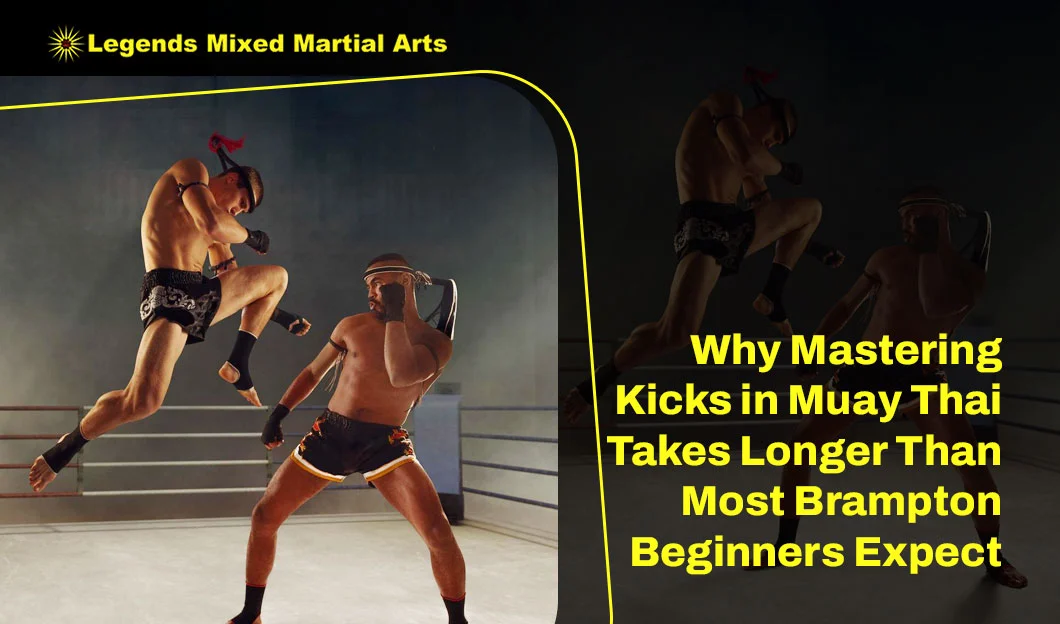
Most people who walk into their first Muay Thai class expect kicks to feel natural within a few weeks because they have watched instructors make it look fluid and straightforward.
What they do not expect is how completely foreign the movement feels the first time they actually try to throw one.
Punches feel instinctive. You have thrown something in the direction of a target before. But a Muay Thai kick is different. Your entire body has to rotate in a way it has never moved, off a foot pivot that feels unstable, at a height your hips may not yet allow.
The gap between what a kick looks like and what it requires is bigger than any other technique in Brampton Muay Thai training. That gap is completely normal and far more common than most beginners realize.
In this blog you will learn why mastering kicks in Muay Thai takes longer than most people expect, and what you can do inside and outside of class to close that gap faster.
Key Takeaways
- Muay Thai kicks require hip rotation, foot pivot, weight transfer, and balance all at the same time.
- Your shins need months of conditioning through repeated pad and bag work before they toughen properly.
- Tight hips and hamstrings from desk-based adult lives directly limit kick height and power from day one.
- Every type of kick—teep, low kick, roundhouse, and high kick—has entirely separate mechanics to learn.
- There is no everyday movement that prepares your body for a Muay Thai kick the way daily life prepares you for a punch.
- Asking for individual feedback, working on hip flexibility between sessions, and drilling the bag outside of class all make measurable differences to how fast your kicks develop.
What Makes Kicks in Muay Thai So Much Harder to Master Than Other Techniques?
The five reasons below explain why Muay Thai kicking techniques develop more slowly than punching combinations, and why that is not a reflection of ability or effort.
A Muay Thai Kick Requires Your Entire Body to Move at Once
Throwing a punch engages your shoulder, arm, and core in a relatively familiar pattern. A Muay Thai kick requires your standing foot to pivot, your hip to rotate fully, your core to engage, your arms to swing for momentum, and your kicking leg to extend—all simultaneously and in the correct sequence.
Most beginners get one or two of these components right in the early sessions. Getting all of them right, in the proper order, under any pressure or fatigue, takes months of deliberate repetition. Muay Thai training has no shortcut for this level of coordination. It has to be drilled until the sequence becomes automatic and your body stops having to think through each component individually.
Your Shins Need Time to Condition Before They Can Work Properly
Unlike punching, where your hands have some natural toughness, your shins are not used to absorbing or delivering repeated impact. The conditioning process involves controlled micro-trauma to the shin bone that, over time, makes it denser and more resilient.
This is not painful in the way most people imagine, but it is a slow physical process. In the first few months of Brampton Muay Thai training, most beginners find their shins sore after bag or pad work. That soreness decreases as the shins adapt. Trying to rush this by overtraining the shins in early sessions causes unnecessary setbacks that delay progress rather than accelerate it.
Most Adults Walk In With Hips That Are Too Tight for Effective Kicks
Adults who spend most of their day sitting at a desk develop chronically tight hip flexors and hamstrings. These muscles directly limit how high and how powerfully you can kick. A high kick in Muay Thai requires a range of hip mobility that most beginners simply do not have on day one.
This is not a permanent limitation. Hip mobility responds well to consistent stretching and mobility work done between sessions. But it does mean the kick you see a trainer throw on your first day is not the kick your body can currently produce. That gap closes gradually over months, not in a matter of weeks, no matter how hard you train in class.
Each Type of Kick Has Completely Separate Mechanics
The teep, the low kick, the roundhouse, and the high kick are not variations of the same movement. Each one uses a different chamber position, a different pivot angle, a different target, and a different hip rotation path. Learning one does not transfer directly to the others.
There are more types of Muay Thai kicks than most beginners realize when they first walk in. This means a beginner working through Muay Thai kicking techniques is effectively learning four distinct skills at the same time, not one skill with minor variations. Experienced coaches at Brampton Muay Thai gyms introduce these progressively rather than all at once because each type demands separate, focused drilling time before it feels natural.
There Is No Everyday Movement That Prepares You for a Muay Thai Kick
You have pushed, pulled, and thrown things throughout your life, which gives your upper body some existing movement patterns to build from when learning punches. Nothing in everyday adult life resembles the hip rotation, pivot, and full-body commitment of a Muay Thai roundhouse.
This means your nervous system is building a movement pattern from scratch every time you practice. Kicks in Muay Thai sit entirely outside your body’s existing library of movements. That is exactly why the early repetitions feel so awkward, and why consistent drilling eventually produces the kind of fluid, automatic kick that looks effortless in experienced practitioners. The awkwardness is not a problem. It is the process working exactly as it should.
How Do You Speed Up Your Kick Development in Brampton Muay Thai Training?
Knowing why kicks take time is useful. Knowing what to actively do about it is even more useful. These three approaches consistently help beginners make faster progress in Muay Thai.
Work on Hip Rotation and Flexibility Between Sessions
The biggest physical bottleneck for most beginners is hip mobility, and addressing it only in class isn’t enough. Ten minutes of daily hip flexor and hamstring work (think hip circles, low lunges, and leg swings) produces measurable flexibility improvements within four to six weeks of consistent practice.
More flexible hips let your kick rotate through its full range naturally, improving both height and power at the same time. This is one of the few areas where work between sessions makes a greater difference to your kicking development than additional class time alone. Your coach can also confirm which specific stretches target the limitations showing up in your technique.
Use Bag Work to Build Repetition Volume Outside of Class
Pad work with a trainer gives you real-time feedback on your technique. Bag work between sessions gives your nervous system the repetition volume it needs to build automaticity. Throwing the same kick deliberately fifty times on a bag between sessions significantly compounds the muscle memory built in class.
Muay Thai classes for adults at a well-structured gym like Legends MMA include bag rounds. Using that time intentionally, focusing on one specific kick rather than general combinations, accelerates the development of whatever technique you are currently working on in class.
Ask Your Coach for Specific Corrections After Every Session
Most beginners assume that if something major was wrong with their kick, their coach would say something in the moment. In a group class, coaches cannot correct every student on every repetition. The students who ask for specific feedback after sessions develop faster than those who wait to be told.
This is also the clearest reason why private Muay Thai lessons accelerate kick development specifically. A private session gives your coach time to watch your kick from multiple angles, identify the exact technical error, and correct it before it becomes a deeply ingrained habit that takes considerably longer to undo later.
Kicks in Muay Thai take longer than most techniques because they demand full-body coordination, physical conditioning, hip flexibility, and separate drilling for each distinct type. You can’t bypass any of those requirements, but all of them respond to consistent, targeted work. The beginners who progress fastest are the ones who train with patience, ask for specific feedback, and do flexibility work between sessions. If you are ready to develop strong, technically sound kicking technique, Muay Thai classes at Legends MMA in Brampton give you the coaching, structure, and right environment to make that happen.