
Choosing between Muay Thai and boxing is one of the most common dilemmas people face when they walk into a combat sports gym for the first time. Both are striking-based martial arts, both build real fitness, and both have active training communities in Brampton. The difference lies in what each sport trains, how it trains, and what kind of results it produces.
Boxing focuses completely on punching; developing hand speed, punch combinations, and defensive head movement with exceptional depth. On the other hand, Muay Thai adds kicks, elbows, knees, and clinch work to the mix. This gives the practitioners a wider range of tools across multiple fighting distances. These are not minor variations of the same sport. They are genuinely different disciplines that suit different goals.
Muay Thai and boxing classes in Brampton each welcome beginners at every fitness level, and neither choice is wrong. What matters is understanding what you want from your training before you commit.
In this blog, you will learn exactly how these two martial arts differ technically, physically, and practically so you can make a confident and informed decision.
Key Takeaways
- Muay Thai uses eight points of contact (fists, elbows, knees, and shins) while boxing is built entirely around punching with the fists.
- Boxing techniques produce sharper hand speed and defensive head movement than any other striking sport.
- Muay Thai training in Brampton develops full-body conditioning because kicks, knees, and clinch work use more muscle groups per session.
- For self-defence, Muay Thai covers more ranges (long, mid, and close) while boxing is strongest at punching range only.
- Both sports build real cardiovascular fitness, mental composure, and disciplined movement habits over months of training.
- The right choice depends entirely on your personal goals, not on which sport is universally “better.”
What Is the Difference Between Muay Thai and Boxing?
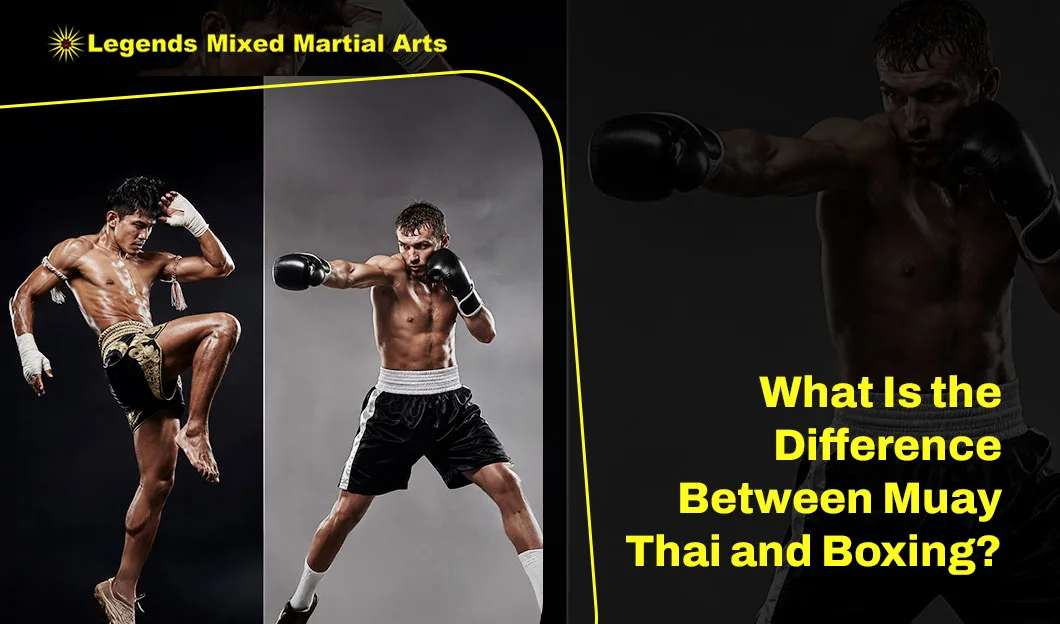
Both sports are built on striking, but the technical gap between them is significant. Understanding what each sport trains, not just in broad terms but in specific physical habits, gives beginners a clear picture of what to expect.
Does Muay Thai or Boxing Use More Weapons?
Boxing uses two weapons: the left fist and the right fist.
- Every offensive and defensive action in boxing revolves around punching and not getting punched. Because the entire sport centres on the hands, boxers develop a level of punch accuracy, timing, and defensive sharpness that no other striking art dedicates as much training time to.
- Boxers develop the jab, cross, hook, and uppercut with a level of refinement that no other combat sport dedicates as much time to.
- Defensive skills like slipping, rolling, parrying, and shoulder rolling are equally developed because the head is the primary target.
Muay Thai uses eight weapons: fists, elbows, knees, and shins.
- Elbows are used at close range where punching becomes difficult.
- Knees are deployed in the clinch, where two fighters grip each other and strike at very short distance.
- Kicks attack at long range with significantly more power than a punch, because the shin and hip generate far greater force than the arm alone.
- This wider arsenal means practitioners can attack and defend at three distinct ranges—long, mid, and close—rather than one.
The clinch is a defining difference between the two sports. In boxing, clinching is a foul that referees break up immediately. In Muay Thai, the clinch is an active fighting position where some of the most damaging strikes are thrown. For anyone whose goal includes self-defence preparation, this distinction matters considerably.
How Do the Stances and Footwork Compare?
Stance and footwork are not surface-level differences; they determine which strikes are available and which attacks can be defended.
A boxer uses a bladed, sideways-facing stance with feet roughly shoulder-width apart. This position narrows the target area, supports lateral movement, and allows the head to slip off the centreline quickly. The footwork is built around creating angles, circling, and generating punching combinations through weight transfer.
A Muay Thai practitioner stands more squarely to the opponent, with the torso more upright and the shins ready to check incoming kicks. This stance sacrifices some of the lateral evasion available in boxing but allows faster access to rear-leg kicks and knee strikes. Taking a boxing stance into a Muay Thai session exposes the lead leg to low kicks immediately. Equally, a square Muay Thai stance in a boxing session leaves the fighter vulnerable to straight punches down the centreline.
Muay Thai or Boxing: Which One Is Better for Fitness and Self-Defence?
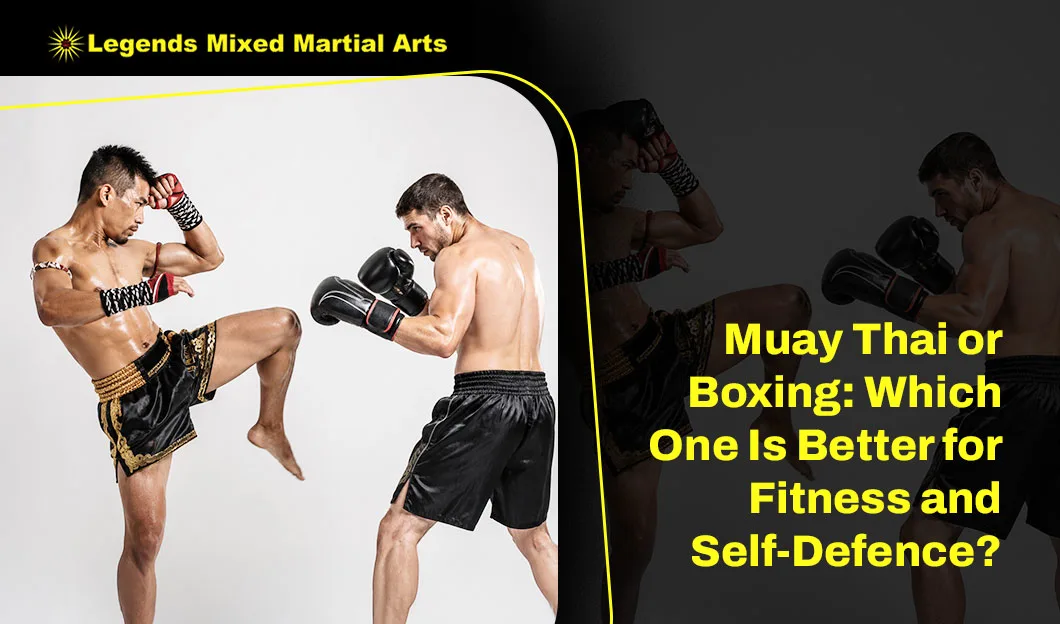
Most beginners ask this question when they compare these sports. Both deserve specific, honest answers rather than vague claims about “overall fitness” or “real-world effectiveness.”
Which Sport Burns More Calories and Builds More Muscle?
Boxing training sessions in Brampton are aerobically intense. Jump rope, heavy bag rounds, pad work, and sparring all demand sustained cardiovascular output. The upper body—shoulders, chest, triceps, and forearms—develops quickly through the repetitive volume of punching. Core strength builds through the rotational mechanics of every punch thrown. Boxing sessions are physically demanding, and practitioners see clear improvements in endurance and upper body composition within the first two to three months.
Muay Thai sessions in Brampton involve more muscle groups simultaneously because of the following demands:
- Roundhouse kicks engage the glutes, hip flexors, and quadriceps with every repetition.
- Knee strikes in the clinch load the core and hip extensors under resistance.
- Clinch work builds shoulder endurance and grip strength that boxing does not replicate.
- Defensive kick-checking works the lateral hip stabilizers and calves continuously throughout sparring.
The result is that Muay Thai classes in Brampton tend to produce more total-body conditioning per session than boxing. This is not a quality judgment. Boxing produces excellent fitness, but the sheer number of muscle groups employed in a Muay Thai session is objectively higher.
What Should You Learn for Self-Defence: Boxing or Muay Thai?
For self-defence, Muay Thai is the more practical choice across a broader range of real-world scenarios. Most physical confrontations do not stay at a comfortable punching distance. They close into the clinch quickly, involve pushes and grabs, and involve someone significantly larger. Muay Thai prepares practitioners for all three of those situations—long-range kicks to create distance, punches at mid-range, and knee and elbow strikes when a confrontation gets close.
Boxing can be beneficial for self-defence skills. A trained boxer has a powerful punch and a steady defence under pressure. The ability to read strikes and avoid danger is something that can be applied elsewhere also. The only problem is that boxing only deals with punch distance, and real-life situations often take you out of that range quickly.
The health benefits of boxing go far beyond self-defence. Boxers have enhanced reflexes, the ability to manage stress and awareness about their bodies. These qualities are important whether a confrontation really occurs. Remember, both sports can build confidence and that alone changes how situations develop before they escalate physically.
Which Martial Art Should You Choose?
Both sports are taught at a high level in Brampton, and both are accessible to complete beginners. The deciding factor is what you want your training to produce.
Who Is Boxing the Right Fit For?
Boxing is for those who want to perfect just one striking art with great depth. If you are intrigued by fast punches, different punch combinations and defensive head movements, then boxing is a very clear way to achieve your goals. As the range of techniques is smaller, it’s easier for beginners to be effective faster.
Boxing classes in Brampton also suit people who are new to contact sports entirely. The learning curve is more accessible initially because the hands have more natural coordination than the legs for most beginners. Within a few weeks, a new student can throw a credible jab-cross combination. That early progress keeps people engaged through the foundational phase of training.
Who Is Muay Thai the Right Fit For?
Muay Thai training in Brampton suits people who want a wider striking range, stronger full-body conditioning, and a skill set that covers multiple combat distances. The learning curve is steeper in the first month, with kicks and elbows being less natural movements than punches, but the reward of more complete striking skills pays off significantly by the three-month mark.
Martial arts training through Muay Thai is also the stronger choice for anyone interested in MMA, as Muay Thai is the most widely used striking base among professional mixed martial artists. At Legends MMA, beginners in both sports are taught with the same emphasis on proper technique, individual coaching attention, and progressive skill development from the very first class.
Muay Thai and boxing are two types of combat sports that produce amazing results. Boxing helps in developing faster hands and good defensive reflexes through a technically intensive approach. Muay Thai helps to acquire broader striking skills and improve the condition of the entire body. There is no absolute winner in this battle; the only comparison should be made through the prism of one’s goals and aspirations. If you decide to take up Muay Thai classes in Brampton, Legends MMA offers classes for beginners with professional coaches and a properly organized training system.